Themed route · start & finish Can Pastilla
Monti-Sion – Castellitx
- Moderate
- 84 km
- 736 m
- ≈ 3–4 h
Map and elevation profile
Move along the elevation profile to see where you are on the map.
Food & coffee stops
Tried-and-tested places where cyclists like to stop for coffee, food or water.
-
Restaurant 31 kmRestaurant Monti-Sion Porreres
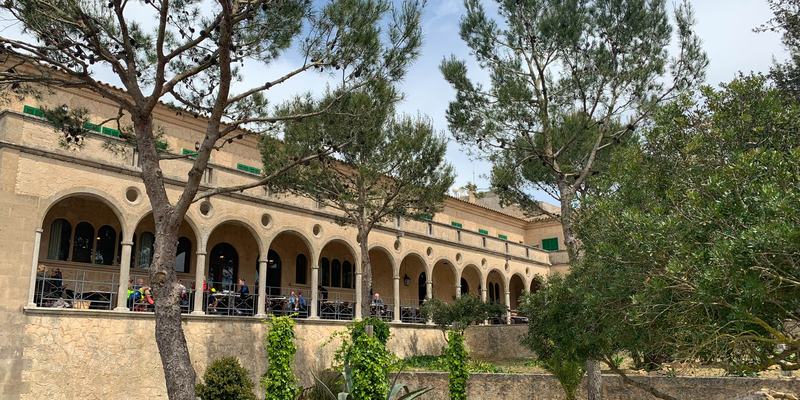
Km 31: bar-restaurant at the sanctuary with a viewing terrace; Mallorcan home cooking from seasonal produce, coffee and drinks. Open Thursday, Saturday and Sunday 9:00–18:00 and Friday 9:00–24:00; closed Monday to Wednesday.
Open in maps ↗ -
Café 49 kmBar s'Hostal Montuïri
Km 49: village bar on the Camí de Manacor, about 200 m off the route, known for its pa amb oli in several sizes with ham, cheese, sobrassada or camaiot. Open Tuesday to Sunday 8:00–24:00, closed on Mondays.
Open in maps ↗ -
Restaurant 56 kmCal Dimoni Algaida
Km 56: restaurant on the old Palma – Manacor road, right on the route as you enter Algaida; sobrassada and meat grilled over almond and walnut wood, plus porcella or arròs brut. Open 9:00–23:00, closed on Wednesdays.
Open in maps ↗
Three sanctuaries of the Pla: Monti-Sion, Sant Miquel, Castellitx
Route summary:
A culture ride into the heart of Mallorca for riders who want more than kilometres: three hilltop sanctuaries that none of our other routes visit. The 84 km loop gains about 740 m, but in small doses – two short climbs to Monti-Sion and Puig de Sant Miquel and a gentle drag up to Castellitx, with long, easy stretches across the Pla in between. Any reasonably fit rider can do it: count on 3.5–4 hours in the saddle, 5–6 with visits and lunch. It is paved practically all the way. Refuel on the terrace at Monti-Sion (km 31, Thursday to Sunday), with pa amb oli at Bar s'Hostal in Montuïri (km 49, closed Monday) or with wood-grilled sobrassada at Cal Dimoni in Algaida (km 56, closed Wednesday).
 Cycling route summary:
Km 0–17: quiet lanes lead to the Ma-19A, the old Llucmajor road, which climbs steadily from km 3 to about 165 m at km 12, then rolls into Llucmajor.
Km 18–29: 11 km on the Ma-5020 to Porreres, open and rolling, with faster regional traffic – ride single file.
Km 30–33: the Monti-Sion spur, 1.8 km at 6.2 % with a few switchbacks; the steepest pitch (up to 9 %) comes early. Same way down.
Km 33–42: the Ma-5030 skirts western Porreres, then quiet lanes lead to the camí vell de Montuïri a Porreres, a narrow old road designated for bikes.
Km 43–46: up Puig de Sant Miquel and back – about 1.4 km of climbing, steepest low down; the last 0.9 km averages 4.6 %.
Km 46–56: through Montuïri on the main streets (the old core is narrow and partly cobbled), then the old road beside the Ma-15, rising gently from 135 to 185 m into Algaida. Stay off the Ma-15 itself.
Km 57–66: the Castellitx loop on narrow farm lanes – the church at km 61, the day's high point (about 245 m) at km 63, then back to Algaida.
Km 66–84: the camí de Cas Brau and a lane beside the Ma-15 drop almost 200 m to the plain; the flat Ma-5013 and Ma-19A lead back to the shop.
 Tourist summary:
This loop is a small pilgrimage across the Pla, the farming heart of Mallorca, where villages crown their hills with sanctuaries. Monti-Sion above Porreres dates from 1498: its pentagonal cloister is unique on the island, its grammar school taught Latin until 1835, and on clear days the view reaches Cabrera. On Puig de Sant Miquel a hermit is documented as early as 1395. Castellitx, alone among the fields, is one of 28 rural parishes created after the papal bull of 1248. On Easter Tuesday Montuïri celebrates its Dia del Puig on the hill and Algaida walks to Castellitx. In between: Porreres and its apricots, Montuïri's windmills and Algaida's restaurants on the old main road.
Climbs click to show on the map
- Santuari de Monti-Sion from Porreres 1.8 km · Ø 6.2 % · max. 9.2 % · top 235 m km 43–45
- Puig de Sant Miquel from Montuïri 0.9 km · Ø 4.6 % · max. 8.4 % · top 228 m km 61–61
Tips from our guides
- Pick your day: the Monti-Sion restaurant opens only Thursday to Sunday, Bar s'Hostal closes on Monday and Cal Dimoni on Wednesday, so Thursday to Sunday works best. Church interiors, especially at Castellitx, are often closed outside services; the grounds and views are worth it anyway.
- Bring a lock and walk the last few metres: bikes stay outside cloisters and churches. Cover your shoulders inside and take care with cleats on the old stone floors.
- Ride single file on the Ma-5020 and Ma-5030, never ride onto the fast Ma-15 and take the junctions near Montuïri and Algaida carefully. Expect tractors on the narrow Castellitx lanes. Any road bike will do: the steepest pitches are around 9 %, and the short ramps to Monti-Sion and Puig de Sant Miquel can simply be walked.
- There is little shade on the Pla. Carry two bottles and refill in Porreres, Montuïri and Algaida. In the afternoon the sea breeze often blows in from the Bay of Palma and can be in your face on the last kilometres to the coast.
- Sunset is around 19:30 in late September and around 18:00 after the clocks change on 25 October. If you stay for Friday dinner at Monti-Sion (open until midnight), you ride home in the dark: a white front light, a red rear light and a reflective garment are mandatory on interurban roads at night.
Did you know?
- The road up to Monti-Sion was built by the people of Porreres in a single day, 14 January 1954, as an act of popular devotion. source
- Castellitx was one of the 28 rural parishes created on Mallorca by Pope Innocent IV's bull of 1248. Under the ordinances of King James II the parish seat later moved to Algaida, and the church became a sanctuary. source
- The first building on Puig de Sant Miquel is documented in 1395, when the hermit Bartomeu Aguilar received a donation to pay for two houses he had built on what was then called the puig de Romanyà. source
Places along the route
-
117 km
Llucmajor
Mallorca's largest municipality by area (327 km²). In 1349 the Battle of Llucmajor ended the independent Kingdom of Majorca; King James III fell in it. The route passes right by the centre, an easy place for a first coffee.
-
231 km
Santuari de Monti-Sion
Founded in 1498 on a hill about 250 m high south of Porreres. Its pentagonal cloister with round arches is unique in Mallorca, and its grammar school prepared students for university in Palma until 1835. Lock the bike at the entrance; the cloister, the church and the view as far as Cabrera take 15–20 minutes on foot.
-
335 km
Porreres
The route skirts the town on the Ma-5030; the main square with the parish church is a detour of about 600 m east. For decades Porreres has been known above all for its apricots. Bar ca'n Guillem on the square opens daily and has bike racks by its sunny terrace – the fallback when the Monti-Sion restaurant is closed (Monday to Wednesday).
-
439 km
Camí vell de Montuïri a Porreres
The old road between the two villages, today a narrow asphalt lane designated for cycling. Few cars, open fields and Puig de Sant Miquel growing ahead of you: the calmest kilometres of the day.
-
545 km
Puig de Sant Miquel
A hill above Montuïri topped by the oratory of the Mare de Déu de la Bona Pau; the first building here is documented in 1395. The view sweeps over the Pla in almost every direction. The summit restaurant was reopened in 2026 by the owners of s'Hostal in Montuïri, initially for evenings and weekends – check its hours before counting on it.
-
648 km
Montuïri
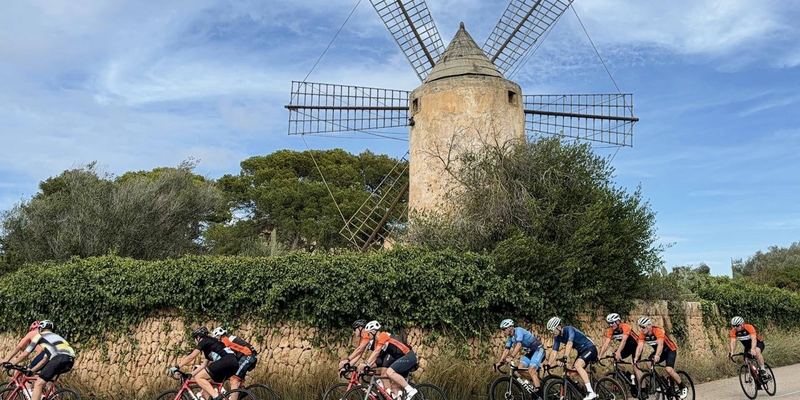
A hilltop village with old windmills on its skyline. Stick to the main streets, carrer de Ramon Llull and carrer de Palma: the old core is narrow and partly cobbled. Bar s'Hostal, the lunch stop, is on the Camí de Manacor in the small industrial estate on the south-west side (km 49).
-
756 km
Algaida
A village on the old Palma–Manacor road, with Cal Dimoni right on the route. Its parish church now keeps the treasures of Castellitx: the 15th-century Gothic altarpiece of Saints Peter and Paul, attributed to Joan Pellisser, and the 1430 image of the Mare de Déu de la Pau. You pass through twice, at km 56 and km 66.
-
861 km
Castellitx
The church of the Mare de Déu de la Pau stands alone on a 226 m hill between fields. It dates from the 13th-century resettlement, when it was one of Mallorca's first rural parishes; the presbytery was added in the 17th century. Don't count on the door being open: the setting and the silence are the reward.
More routes
All routes →Rides of similar difficulty you might also like.